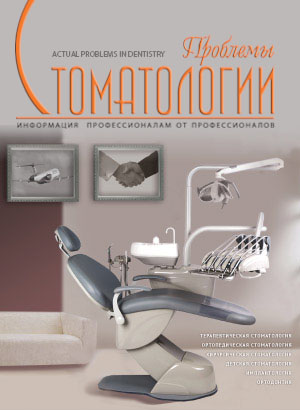
Обложка журнала
Title
ACTUAL PROBLEMS IN DENTISTRY
Language of publication
Russian
ISSN
2077-7566 (print) 2412-9461 (online)
Periodicity

4 issues per year

Russian science citation index:
Yes 31956
Russian higher attestation Commission:
Yes

Formatting Requirements

Sample article design (with comments)


FORMATTING REQUIREMENTS FOR THE ARTICLES

1. Article elements

Abstract

Keywords

Text of article

Acknowledgements

References

2. Text

2.1. General requirements. The article length should be 10- 20 typewritten pages (30 000 – 40 000 characters). Before sending the article please use spellcheck and take one of the recent published papers as an example. This eliminates the deformation of graphics and formulas. Page setup: margins – Left - 3 cm, Right 2 cm, top -2 cm, bottom – 2 cm, 1.5 spacing, standard tab stop (1.27 cm); font – TimesNewRoman 12 pt. Use the standard fonts and uniform design both for the whole text and for all its elements.

2.2. The abstract volume is 200-250 words. The abstract should include the following parts:

— subject, topic, aims, research hypothesis;
— methods;
— results;

— results application;
— conclusion, discussion;
— limitations, themes for future research.
The abstract should show special aspects, novelty and advantages of the research as to interest the reader and make him/her to read the whole paper. It is an independent text describing the main results of the research without reference to the article, so reference citations and abbreviations must be avoided. Make the abstract’s style clear and concise, free from secondary information.

2.3. Keywords should countnot less than 10 words, without full point.

2.4. Structure of article

The article should be written in the IMRAD format (Introduction, Methods, Results and Discussion) and have the following structure:
— Introduction;

— Theory;
— Data and Methods;
— Methods or Model;
— Results;
— Conclusions or Discussion and Implication.

3. Figures

The paper should not contain photos, all figures should be in the black and white format. Make all graphic objects visual, demonstrative and clear. Illustrations should be numbered and placed after they are first referred to in the text. State the figure’s name below the figure (in italics). The figures should be made in a format that allows editing and configuration changes without further recourse to the author. Full-color figures will are not allowed, as well as partly colored figures. The figures are uploaded to the system as separate files in original format (*jpeg, *jpg, *tiff, *xls), except figures made in Microsoft Word. The figures created by means of MS Word should be grouped together. The objects created by other means than MS Word should have *jpeg (*jpg), or *tiff extension, with a resolution not less than 72 dpi (screen resolution) and size of at least 1500x1500 (dots per inch), or 164 mm width and 300 dpi. The author is responsible for the correct using of characters, formulas and figures.

4. Tables

In the tables, the numbers are aligned to the right (in italics), the title of the table is in the center (in bold). The tables should be untitled and numbered consecutively. Please avoid overcrowding the tables and the excessive use of words, colored text and cells. The author should indicate the sources of the data provided in tables.

5. Language standards

Write the paper in a good English. The translation from native languages should be made by professional translators or edited by proof-reader. Machine translations will be rejected. The authors should respect English spelling and punctuation. Papers which need to be substantially edited can be returned to the author.

6. References

The reference section is written at the end of the article and should contain at least 20 - 30 sources (foreign - not less than 30%). Self-citations should not exceed 15%. Sources are numbered in alphabetical order. If you refer to several sources at once you should group them to the single integrated reference. Examples of references in the text of paper: [15]; [1, 15, 34]; [1, 8–22].

Examples

6.1. Journal articles with DOI:

Author, A. A. (Year of publication). Article Title. Journal Title, vol. (no.), pages. doi.
e.g. Monastyrny, E. A. (2006). Innovative cluster. Innovations, 2, 38-43. doi:10.1037/0278- 6133.24.2.225.
6.2. Journal articles without DOI:
Author, A. A. (Year of publication). Article Title. Journal Title, vol. (no.), pages.
e.g. Monastyrny, E. A., & Kulik, J. A. (2005). Social and economic development. Economy of Region, 3, 39-52.
Monastyrny, E. A., Kulik, J. A., Nulif, K. L. (2008). Social and economic development. Economy, 3, 52-67.

6.3. Books:
Author, A. A. (Year of publication). Title of book (Edition). Location: Publisher, pages. e.g. Monastyrny, E. A. (2006). Innovative cluster. Moscow: Nauka Publ., 267.
Duncan, G. J., & Brooks-Gunn, J. (Eds). (1997). Consequences of growing up poor. New York, NY: Russell Sage Foundation, 350.
Plath, S. (2000). The unabridged journals. K. V. Kukil (Ed.). New York, NY: Anchor, 680.

6.4. Chapter in a book:
Author, A. A., & Author, B. B. (Year of publication). Title of chapter. In A. A. Editor & B. B. Editor (Eds). Title of book (pages of chapter). Location: Publisher. e.g. Monastyrny, E. A. (2006). Innovative cluster. In J. A. Kulik (Ed.). Innovations (pp. 12-21). Moscow: Nauka Publ.

6.5. Electronic sources (Web publications):

Links to websites, online sources (does not apply to original articles, monographs, etc., posted on the Internet), legal documents (laws, resolution, acts, etc.), newspapers and statistical collections are placed in the text in footnotes and should not be mentioned in the reference list.
Standard for references conforms to the requirements of APA (the American Psychological Association). For each internet-source it necessary to indicate the Date of access. For all sources having doi, please, indicate it at the end of the source.

Author, A. A., & Author, B. B. (Date of publication). Title of article. Title of Online Periodical, volume number (issue number if available). [Electronic source] Retrieved from http://www.someaddress.com/full/url/ (Date of access: dd.mm.yyyy)..
e.g. Tatarkin, A
. I. (2013). Self-development of regional socio-economic systems as the need for Russia’s federal development. Economy of Region, 4. [Electronic source] Retrieved from http://economyofregion.com/archive/2013/47/2164/pdf/ (Date of access: 14.04.2016).

Papers which don’t meet these requirements can be returned to the authors for revision.

THE ETHICS OF SCIENTIFIC PUBLICATIONS

  1. General Provisions

The editors, editorial staff and publisher of Actual problems in dentistry adhere to ethic standards of the international scientific society and strive to prevent any violations of these norms. 

The editors, editorial staff and publisher of the Journal base their activities on the code and recommendations of the Committee on Publication Ethics (COPE), Publication Ethics and Publication Malpractice Statement of Elsevier, and the Declaration of the Association of Science Editors and Publishers “Ethical principles of scientific publications”, as well as pay special attention to the experience of reputable international journals and publishing houses. 

Below are the principles of ethical conduct mandatory for all parties involved into reviewing and publishing a manuscript: author(s), reviewers, the editorial staff, editorial board and publisher of the Journal. 

Adherence to the ethical code by all participants ensures the compliance with intellectual property rights, enhances the quality of the Journal in the eyes of the international scientific society, and prevents unlawful use of the authors’ materials for the benefit of other parties. 

  1. Duties of Authors

The authors are personally responsible for the text of the manuscript they submit, which means complying with the following rules: 

  • The original manuscript as submitted should not be under consideration for publication or published earlier elsewhere;
  • Research results described in the manuscript are to be an independent and original study. Excessive adoptions, any plagiarism including quotations without references, rephrasing or capture the right for results of someone else’s research are unethical and unacceptable. The manuscripts compiled from materials published earlier by some other authors without original revision and personal reasoning of the author are not accepted for publication in the journal;
  • Submission of reliable results of the conducted research or work;
  • Acknowledgment of all those contributing to the progress or defining the character of the research. In particular, the manuscript is to include references to Russian and foreign publications which were valuable for the research;
  • All those making significant intellectual contribution into the manuscript’s concept and structure, as into conduction of the research or interpretation of the results are to be mentioned as co-authors. Gratitude is to be expressed to the other participating in certain aspects of the research. No one not involved into the research is to be mentioned as a co-author;
  • Should some significant errors or inaccuracy be identified in the manuscript while it is being reviewed or after it has been published, the editors are to be notified of this immediately and a joint decision is to be taken about confessing the error and/or its correction within the shortest period. Should the editors learn from a third party that the published manuscript contains significant errors, the author must immediately remove or correct such errors or provide the editors with the proves that submitted information is correct;
  • All funders of the research are to be mentioned;
  • The author should declare any conflict of interests, which can exert certain influence on the research results, their interpretation, and the opinion of the reviewers.
  1. Duties of Reviewers

The reviewer performs the scientific expert evaluation of the author’s materials, the evaluation is to be unbiased and compliant with the following rules:

  • Expert evaluation is to assist to the author to enhance the quality of the manuscript’s text and to the editor-in-chief to make the decision about publication;
  • Any selected referee who feels unqualified to review the research reported in a manuscript or knows that its prompt review will be impossible should notify the chief editor and excuse himself from the review process;
  • The author or co-author of the manuscript cannot be the reviewer as well as academic advisors of post-graduate students and/or those working together with the author in the same department;
  • Any manuscripts received for review must be treated as confidential documents. They must not be shown to or discussed with others except as authorized by the editor;
  • The reviewer is to be free of prejudices. Personal remarks to the author are inappropriate. The reviewer’s opinion is to be expressed clearly and reasonably;
  • The reviewer is to draw the attention of the editor-in-chief to the significant similarity or partial overlapping of the reviewed manuscript with any other one published before.
  1. Duties of Editors

The editors and editorial board members are responsible for public disclosure of the authors’ manuscripts which implies adherence to the following rules: 

  • Implementing independent policy for selection and publication of the materials presenting scientific and practical research;
  • Ensuring compliance of the published materials with accepted international standards and ethical code;
  • Enhancing the Journal quality for meeting requirements of readers and authors to the full;
  • Cooperation with authors and reviewers in order to provide high quality of published materials;
  • Rejection or acceptance of materials for publication is to be based on importance, originality, clarity and relevance of the research with the consideration of its intellectual content without any discrimination on grounds of race, gender, sexual orientation, religion, ethnic origin, nationality or political belief of the author;
  • Publication of materials reflecting different scientific opinions, with the right to reduce the materials to be published, edit them and adapt to the journal headings;
  • Confession of committed errors and if necessary publication of corrections, clarifications, refutations and apologies. 

The editor-in-chief is responsible for making decisions on the publication of the submitted materials, estimating reliability and importance of the study for researchers and readers as well as its compliance with legal requirements (copyright infringement, plagiarism, and libel). When making decision on publication, the editor-in-chief consults the editorial board or reviewers. 

  1. Duties of Publishers

In the course of business the publisher is responsible for public disclosure of the authors’ manuscripts which implies adherence to the following rules: 

  • Assisting in fulfillment of ethical responsibilities of the editors, editorial board, reviewers and authors in compliance with these requirements;
  • Supporting the editorial staff in reviewing objections to ethical aspects of the published materials and assisting in cooperation with other journals and/or publishers if it is useful for editors during performance of their duties;
  • Assuring confidentiality of all information received from the authors till its publication;
  • Confidence that potential profit from advertisement will not exert influence on the editors’ decisions on acceptance of the manuscript for publication;
  • Promptitude in the publication of corrections, explanations, refutation and apologies when necessary;
  • Provision of the editorial staff with the opportunity to exclude publications containing plagiarism and unreliable data.
  1. Informed consent and human and animal rights 

Activities of Actual problems in dentistry are based on the WMA Declaration of Helsinki - Ethical Principles for Medical Research Involving Human Subjects and the journal team strives for complying with ethical norms and rules of data collection for research involving human subjects.

Medical research involving human subjects must conform to generally accepted scientific principles, be based on a thorough knowledge of the scientific literature, other relevant sources of information, and adequately conducted laboratory reports along with studies in animals where applicable.  The welfare of animals used for research must be respected.

Before starting any research the researcher should familiarize him/herself with the informed consent provisions of the WMA Declaration of Helsinki and perform the research in the strict compliance with the principles presented below (Items 25-31 of the WMA Declaration of Helsinki):

  1. Participation by individuals capable of giving informed consent as subjects in medical research must be voluntary. Although it may be appropriate to consult family members or community leaders, no individual capable of giving informed consent may be enrolled in a research study unless he or she freely agrees.
  2. In medical research involving human subjects capable of giving informed consent, each potential subject must be adequately informed of the aims, methods, sources of funding, any possible conflicts of interest, institutional affiliations of the researcher, the anticipated benefits and potential risks of the study and the discomfort it may entail, post-study provisions and any other relevant aspects of the study. The potential subject must be informed of the right to refuse to participate in the study or to withdraw consent to participate at any time without reprisal.  Special attention should be given to the specific information needs of individual potential subjects as well as to the methods used to deliver the information.

After ensuring that the potential subject has understood the information, the physician or another appropriately qualified individual must then seek the potential subject’s freely-given informed consent, preferably in writing.  If the consent cannot be expressed in writing, the non-written consent must be formally documented and witnessed.

All medical research subjects should be given the option of being informed about the general outcome and results of the study.

  1. When seeking informed consent for participation in a research study the physician must be particularly cautious if the potential subject is in a dependent relationship with the physician or may consent under duress. In such situations, the informed consent must be sought by an appropriately qualified individual who is completely independent of this relationship.
  2. For a potential research subject who is incapable of giving informed consent, the physician must seek informed consent from the legally authorized representative.  These individuals must not be included in a research study that has no likelihood of benefit for them unless it is intended to promote the health of the group represented by the potential subject, the research cannot instead be performed with persons capable of providing informed consent, and the research entails only minimal risk and minimal burden.
  3. When a potential research subject who is deemed incapable of giving informed consent is able to give assent to decisions about participation in research, the physician must seek that assent in addition to the consent of the legally authorized representative.  The potential subject’s dissent should be respected.
  4. Research involving subjects who are physically or mentally incapable of giving consent, for example, unconscious patients, may be done only if the physical or mental condition that prevents giving informed consent is a necessary characteristic of the research group. In such circumstances, the physician must seek informed consent from the legally authorized representative.  If no such representative is available and if the research cannot be delayed, the study may proceed without informed consent provided that the specific reasons for involving subjects with a condition that renders them unable to give informed consent have been stated in the research protocol and the study has been approved by a research ethics committee. Consent to remain in the research must be obtained as soon as possible from the subject or a legally authorized representative.
  5. The physician must fully inform the patient which aspects of their care are related to the research.  The refusal of a patient to participate in a study or the patient’s decision to withdraw from the study must never adversely affect the patient-physician relationship.
  6. For medical research using identifiable human material or data, such as research on material or data contained in biobanks or similar repositories, physicians must seek informed consent for its collection, storage and/or reuse.  There may be exceptional situations where consent would be impossible or impracticable to obtain for such research.  In such situations, the research may be done only after consideration and approval of a research ethics committee.

When submitting results of experimental research involving human subjects, the authors should specify if the performed procedures compiled with the code of ethics provided in the WMA Declaration of Helsinki. If the principles of the WMA Declaration of Helsinki were not considered during the research, the authors should justify their approach to the research and guarantee that the ethics committee of the organization where the research was conducted approved of such an approach.

The journal "Problems of Dentistry" publishes in Russian (or English) language works on all sections of dentistry, as well as related sciences. The publication accepts the results of original research, theoretical and overview articles of interest to the scientific community.

Applications for publication in the magazine are accepted through the site https://dental-press.ru/ru/nauka/. Before you apply, you need to undergo a small registration procedure.

The text of the article is made in an on-line editor built into the system. Metadata is entered into separate fields intended for this purpose.

Additional materials (cover letters, etc.) are uploaded in the section "downloading a file" when preparing an application for publication.

The decision to publish is taken by the editorial board of the journal on the basis of expert reviews of reviewers, taking into account the correspondence of the materials of the thematic focus of the journal, their scientific significance and relevance. On changing the status of the application, the author receives a notification by e-mail.

Received manuscript is sent for review to specialists in this field of research. The choice of reviewers remains with the editorial board of the journal. The manuscript, which received negative reviews from two independent reviewers, is rejected by the editorial board's decision. The article, which needs further development, is sent to the authors with the comments of the reviewer and the scientific editor. Authors should take into account all comments made during the review and editing of the article, respond to each of the comments and indicate the place in the manuscript where the changes are made. In case of disagreement with the reviewer or the editor, the author should briefly and clearly substantiate his position. The author's changes in the manuscript must be made in the electronic version of the text and returned to the editorial office. The editors do not provide the authors with a copy of the proof of the article on paper. The article sent by the editorial staff for revision after reviewing and corrected in accordance with the comments of the reviewer must be returned to the editor within 15 days from the moment of its receipt by the authors. An article returned to the editorial office after a month has passed will have a new date of receipt.

Each article generates a contract, which the author receives by e-mail notification. The contract must be printed and signed in 2 copies. send to the editorial office at: 620109, Ekaterinburg, ul. Metallurgov, 4a-3

Peer-Review

A double-blind peer review method is mandatory for processing of all scientific manuscripts submitted to the editorial stuff of Actual problems in dentistry. This implies that neither the reviewer is aware of the authorship of the manuscript, nor the author maintains any contact with the reviewer.

  1. The journal reviews all scientific manuscripts corresponding to the journal subject matter and submitted to the editorial stuff with the aim of giving an expert opinion. Members of the editorial board and editorial council as well as leading Russian and international experts in corresponding areas of life sciences, invited as independent readers, perform peer reviews. All reviewers are acknowledged experts in the subject of reviewed articles and had their work on subject in question published in the last three years. The editor-in-chief, deputy editor-in-chief, science editor, and head of the publishing house choose readers for peer review. We aim to limit the review process to 2-4 weeks, though in some cases the schedule may be adjusted at the reviewer’s request.
  2. Reviewer has an option to abnegate the assessment should any conflict of interests arise that may affect perception or interpretation of the manuscript. Upon the scrutiny, the reviewer is expected to present the editorial board with one of the following recommendations:
    - to accept the paper in its present state;
    - to invite the author to revise their manuscript to address specific concerns before final decision is reached;
    - the final decision to be reached following further reviewing by another specialist;
    - to reject the manuscript outright.
  3. If the reviewer has recommended any refinements, the editorial staff would suggest the author either to implement the corrections, or to dispute them reasonably. Authors are kindly required to limit their revision to 2 months after the date of notification and resubmit the adapted manuscript within this period for final evaluation.
  4. Should the author decide to refuse from publishing the manuscript, they are to notify the editor verbally or in writing. In case the author fails to do so within 3 months since receiving a copy of the initial review, the editorial board takes the manuscript off the register and notifies the author accordingly.
  5. If the author and reviewers meet insoluble contradictions regarding revision of the manuscript, the editorial board has a right to send the manuscript for further examination. In a conflict situation the editor-in-chief resolves it at the editorial board meeting.
  6. The editorial staff sends to the authors of the submitted manuscripts copies of reviews or reasonable refusal. The editorial staff takes on the obligation to give the copies of reviews to the Ministry of Education and Science of the Russian Federation upon the request. The editorial board reaches the final decision to reject a manuscript on the hearing according to reviewers’ recommendations, and duly notifies the authors of their decision via e-mail. The board does not accept previously rejected manuscripts for re-evaluation.
  7. Upon the decision to accept the manuscript for publishing, the editorial staff notifies the authors of the scheduled date of publication.
  8. Kindly note that positive review does not guarantee the acceptance, as final decision in all cases lies with the editorial board. By his authority, the editor-in-chief rules final solution of every conflict.
  9. Original reviews of submitted manuscripts remain deposited for 5 years.

The procedure for recall (retraction) of an article in the journal «Actual problems in dentistry»

(developed based on the recommendations of the Council for the Ethics of Scientific Publications

Association of Scientific Editors and Publishers)


1. The withdrawal of the text from the publication (retraction) is a mechanism for correcting published information and notifying readers that the publication contains serious flaws or erroneous data that cannot be trusted. Data inaccuracy may result from good faith misconduct or deliberate misconduct. Retraction is also used in case of duplicate publications, plagiarism, concealment of conflicts of interest that could affect the interpretation of data or recommendations for their use.
2. The following facts are the basis for recalling an article:
  • detection of incorrect borrowings (plagiarism) in the publication;
  • duplication of articles in several publications;
  • detection of fraud or fabrication in the work (for example, manipulation of experimental data);
  • detection of serious errors in the work (for example, incorrect interpretation of the results), which casts doubt on its scientific value;
  • incorrect composition of the authors (persons included who did not participate in writing the article, conducting research, etc .; persons who were directly involved in conducting the research and writing the article are not indicated);
  • hidden conflict of interest;
  • republishing an article without the consent of the author;
  • The article did not go through the review process.
3. The initiator of the procedure for revocation (retraction) of an article may be:
  • the author (s) of the article, which sends a written motivated appeal to the editorial office of the journal about recalling the article;
  • the editor-in-chief of the magazine, which is preparing a reasonable idea of ​​the reasons for withdrawing the publication;
  • The editors of another journal, which sent a request to the editors of the journal «Actual problems in dentistry»;
  • other persons who have presented evidence of a violation of scientific ethics by the author (s) of the article (for example, participants in a conflict of interest).
4. Recall (retraction) of articles in the journal «Actual problems in dentistry» is as follows:
4.1. After the appeal of the author or another person who has provided evidence of a violation of scientific ethics in the article, the editorial board of the journal appoints a commission that conducts a comprehensive study of the case, taking into account all the facts and possibilities of verifying the ethics of publication;
4.2. Having decided to withdraw the article, the editors indicate in the minutes of the meeting the reason for the retraction (in the case of plagiarism, indicating the sources of borrowing), as well as the date of the retraction. The article and the description of the article remain on the journal’s website as part of the corresponding issue of the journal, but the word RETRACTED and the date of retraction are inscribed on the electronic version of the text, the same note is placed in the article in the table of contents of the issue. 
4.3. The editors do not mechanically delete articles from the electronic version of the journal and from the archive on the journal’s website, in order to maintain correctness.
4.4. A protocol is provided to the Council for the Ethics of Scientific Publications of the Association of Scientific Editors and Publishers (for entering information into a single database of retracted articles), which indicates the date of the meeting, the composition of the meeting, the results of the examination, an informed decision and the completed form:
  • Name of the author and title of the article;
  • the name of the publication from which the text is withdrawn;
  • initiator of article recall; 
  • the basis for the recall of the article and the date of the decision;
  • a link to a page on the publication’s website that provides information about retraction;
  • the output of the article and DOI (if any);
  • topics (social sciences; agriculture, etc.).
4.5. Information on recalled texts is transmitted to the scientific information databases - the NEB, CyberLeninka. Upon receipt of an application for retraction, information about the article and the full text remain on eLibrary.ru and in CyberLenink, but is supplemented by information about retraction. Recalled articles and references from them are excluded from the RSCI and do not participate in the calculation of indicators.
4.6. In case of serious moral damage to the parties to the conflict of interest, information on the fact of violation of scientific ethics can be transmitted to the author’s place of work.
4.7. The editors reserve the right to make their own decisions regarding further cooperation with authors of retracted articles (complete refusal to cooperate, refusal to cooperate for a certain time, appointment of an additional examination of articles in case of repeated cooperation).

You can subscribe to the print version of the magazine through the editorial office by calling +7 (908) 920-84-78 or by sending a request by email to ps-press@mail.ru

Please provide the subscriber's full name, contact phone number, and mailing address (including postal code)/email address where the magazine will be sent. If the subscription is issued to a legal entity, please include a company identification card for the contract and invoice.

From January 1, 2026:

The annual subscription price for the print version is 8,800 (eight thousand eight hundred) rubles.

The annual subscription price for the electronic version is 6,800 (six thousand eight hundred) rubles.

Subscriptions are issued for a one-year period starting from the current month.

Articles are published for a fee.

The publication fee is calculated after receiving a positive review and approval of the manuscript, formatted according to the journal's requirements.

Starting January 1, 2026, the publication fee for one (1) page of a manuscript is 1,900 (one thousand nine hundred) rubles.

For example, an article has 15 pages: 15 pages * 1,900 rubles/page = 28,500 rubles.

The total publication fee cannot be less than 19,000 rubles (if the article is less than 10 pages long, the publication fee will be 19,000 rubles).

An annual subscription to the journal (print or online) is also required.

For terms and conditions, see the "Subscription and Purchase" section.

AI Usage Policy

ARTIFICIAL INTELLIGENCE USE POLICY of the "TIRAZH" Publishing House

Effective date: 04.08.2026 Last updated: 04.08.2026

Use of AI Tools in the Publications of TIRAZH Publishing House Journals

We welcome the responsible and transparent use of artificial intelligence (AI) in medical scientific research and manuscript preparation for the scholarly periodicals of TIRAZH Publishing House. AI can become a powerful tool for improving the quality and efficiency of your work.

We are committed to upholding scientific integrity and encourage authors, reviewers, and editors to use AI as an assistant, not as a substitute for critical thinking and ethical standards.


AI Usage Policy for Authors of TIRAZH Publishing House

Key principles for authors when preparing a manuscript using AI

Authorial responsibility: authors always bear full responsibility for the content of their manuscript, including any information generated or processed by AI.

Transparency: it is essential to indicate where and how AI tools were used (for example, for data analysis, text writing, image creation, etc.).

Ethics and accuracy: it is necessary to ensure that AI does not generate false or incorrect information (hallucinations); all facts and references must be verified.

Data confidentiality: it is not recommended to upload confidential information, patient data, or any other protected information into publicly available AI tools.

Permitted uses of AI by authors

  • Improving language and style: paraphrasing, improving readability, grammar and spelling checks (but not generating the main text).
  • Synthesizing and summarizing information: assistance with literature review, data systematization.
  • Data analysis: applying AI algorithms to process and analyze large datasets, pattern recognition, provided the methodology of such analysis is clearly described.
  • Creating visual materials: assistance in creating graphs, diagrams, images (with mandatory disclosure that AI was used, and confirmation of the originality of the data).

Restrictions and prohibitions for authors

General principles

AI must not replace professional expert judgment. The use of any AI tools (including generative language models, image processing models, analytical and optimization algorithms) does not relieve authors of responsibility for the reliability, scientific validity, and ethics of the presented data, methods, and conclusions.

Authors are required to transparently disclose the use of AI (see the separate section "Disclosure of AI Use"). Failure to comply with disclosure requirements may be regarded as a violation of publication ethics.

Prohibited practices

Passive or hidden generation of scientific content It is prohibited to present as one's own original work text, data, analysis results, or interpretations fully or partially generated by AI, without explicit and detailed disclosure of the AI's role and contribution. It is prohibited to list AI as an author. Only human authors may be listed as authors. AI must not be listed as a co-author, editor, or person responsible for the content.

Fabrication and falsification of data via AI It is strictly prohibited to use AI to create fictitious clinical data, falsify experimental results, simulate patients, or generate "fake" datasets presented as real. Any synthetic or simulated data must be explicitly labeled, described in detail in the methods section, and justified with a statement of limitations. If synthetic data are used for model training, this must be disclosed and supported by the availability of source code/settings for verification.

Manipulation of medical research images It is prohibited to automatically or manually alter clinical images (e.g., X-rays, CT, MRI, microscopic images) with the aim of distorting the clinical picture or results, unless such alterations are described, justified, and approved through appropriate authorial and institutional procedures. Altered images must be accompanied by a statement of the type of alteration (contrast correction, noise reduction, restoration, etc.), the tools and parameters used, and justification. It is prohibited to remove or add pathological features using AI.

Violation of confidentiality and security of personal data It is prohibited to upload personally identifiable medical data (PIMD) or other confidential patient data into cloud-based or third-party AI services without the patients' explicit consent and without ensuring compliance with data protection legislation. It is prohibited to use AI services with an unknown data storage/use policy to process confidential information. Authors must choose tools with documented security guarantees and/or apply anonymization confirmed by methodology.

Copyright infringement and plagiarism via AI It is prohibited to use AI to automatically compile text, graphs, or images protected by copyright without appropriate rights or citation. Generating text clearly based on others' work without indicating sources is considered plagiarism. When using AI to retell, summarize, or translate others' publications, proper citation and compliance with fair use rules must be ensured.

Uncontrolled output and medical recommendations It is prohibited to publish clinical recommendations, diagnostic conclusions, or therapeutic decisions fully formed by AI without verification by qualified specialists and without stating the model's limitations. Any claims about effects on patient care must be based on clinical data and expert evaluation. It is prohibited to use AI-generated scenarios, recommendations, or predictions to support claims about the benefit or safety of interventions without adequate evidence and verification.

Mass automation of submission and manipulation of the peer-review system It is prohibited to use AI for mass automated submission of manuscripts, falsification of reviewer feedback, creation of fake reviewer accounts, or other actions aimed at bypassing the review process. Authors and reviewers must not use automated tools to create unreliable or misleading reviews and comments.

Restrictions on methodology and reproducibility All AI models used for analysis or generation of results must be described in detail: architecture (if relevant), model version, hyperparameters, training data sources, validation procedures, metrics applied, and the code/scripts for reproducing the results, or a link to a repository. If commercial or closed models were used, authors should, where possible, provide access to input data, seed values, and generation parameters to ensure reproducibility. If this is not possible due to licensing, the limitations must be described in detail and alternative verification methods provided.

Liability and consequences of violations

Violation of the above restrictions may result in a request for corrections, an expression of concern regarding the publication, retraction of the article, a ban on submitting new manuscripts, and notification of the author's institution for investigation. In cases of detected data falsification, serious breaches of confidentiality, or fraud, the journal reserves the right to refer the materials to the relevant regulatory authorities.

Disclosure of AI use by authors

Authors are required to clearly and thoroughly indicate the use of AI tools at all stages of manuscript preparation, including:

  • text generation (including parts of the introduction, discussion, conclusions, or abstract);
  • preparation or verification of data, including statistical analysis, visualizations, or data synthesis;
  • preparation of translations, paraphrasing, or text editing;
  • literature searches or compilation of reference lists;
  • creation or processing of images, graphs, diagrams, audio, and video materials.

The use of AI is indicated in the "Methods" section (for research articles) or in a dedicated "AI Use Statement" section (for other types of articles, such as reviews or case reports).

For each mentioned use, the following must be indicated:

  • The name of the AI tool(s) and its (their) version.
  • The tool's manufacturer (if applicable).
  • The specific purpose and manner of AI use (e.g., "AI tool X was used for stylistic editing of the text," "Program Y was used for initial data categorization," "ChatGPT-4 was used to generate introduction suggestions, which were then refined by the authors").
  • Any prompts that had a significant influence on the generated content (where possible).

Recommendations for authors on safe AI use

  • When processing medical data, preference should be given to local or certified solutions that ensure control over the data.
  • Anonymize data according to recognized standards and document the anonymization process.
  • Keep logs of interactions with AI tools, including prompts, generation parameters, and responses received, in order to be able to provide them upon request from the editorial board or reviewers.
  • Thoroughly verify all facts, references, figures, and conclusions generated by AI, as AI models may "hallucinate" (produce false but plausible information).

Exceptions: the use of basic grammar and spelling checking tools (such as Microsoft Word spell-check) that are not based on generative AI does not require mandatory disclosure.


AI Usage Policy for Reviewers of TIRAZH Publishing House

This policy establishes guidelines and requirements for the use of AI tools by reviewers evaluating manuscripts for TIRAZH's medical scientific journals. The goal is to ensure transparency, protect confidentiality, and maintain scientific integrity when integrating AI into the review process.

The policy applies to all external and internal reviewers involved in the peer review of manuscripts (research articles, reviews, case reports, etc.), as well as to editorial staff using AI in preparing review recommendations.

General principles

Peer review must remain a professional, independent process based on human expertise. AI tools may be used only as an auxiliary aid; final judgments and recommendations must be made by a human reviewer. The reviewer bears responsibility for the completeness, accuracy, and ethics of the review.

Permitted use of AI by reviewers

  • Assistance with clarifying wording, style, and structure of the review text (formatting, grammar), provided that the substance of the evaluation and scientific critique are formulated by the reviewer.
  • Quick search and summarization of publicly available information (e.g., extraction of key facts from non-specialized sources), provided this does not breach the confidentiality of the manuscript.
  • Automatic checking of references, citations, and basic formal aspects (e.g., compliance with journal requirements), provided the results are verified by a human.
  • Use of specialized AI tools designed to assist in methodological evaluation (e.g., statistics checking), only if the tool is certified/clearly described and the results are confirmed by the reviewer's independent expertise.

Prohibited use of AI by reviewers

  • No manuscript content (texts, data, figures, tables, unsolicited supplementary materials) may be entered into publicly available or cloud-based AI services without explicit permission from the editorial board and compliance with confidentiality rules.
  • Using AI to automatically generate full reviews, conclusions about scientific value, or recommendations without substantial and critical verification by the human reviewer.
  • Using AI tools that store or index uploaded materials and may use them for model training, if this violates confidentiality or copyright.
  • Transferring confidential, unpublished manuscript information to third parties via AI services.

Confidentiality and reviewers' handling of manuscript data

  • Manuscripts are subject to strict confidentiality; the reviewer must comply with the journal's policy on non-disclosure of materials.
  • Before using any AI service, the reviewer must check the terms of service and data processing policy. If a service stores/uses uploaded data for model training or has unclear storage practices, such a service must not be used to process parts of the manuscript.
  • If it is necessary to use AI to process the manuscript text (e.g., summarization), the reviewer must obtain the editorial board's consent. The editorial board may require the use of internal or certified tools with confidentiality guarantees.
  • Any intermediate files, notes, or conclusions generated using AI and containing elements of the manuscript must be stored and deleted in accordance with the journal's data retention policy.

Disclosure of AI use by reviewers

If, during the preparation of a review, the reviewer used AI to analyze the manuscript (other than for proofreading/grammar), this must be indicated in the cover note to the editorial board when submitting the review. State the name of the tool and briefly describe the nature of the functions used (e.g., "summarization of methods," "checking of statistical tests," "rephrasing of the review text").

Disclosure is also required if the AI's output significantly influenced the evaluative judgments or recommendations (e.g., a conclusion about incorrect analysis suggested by AI).

Disclosure does not imply transferring the manuscript's content to third parties. It is necessary for transparency and to allow the editorial board to assess the appropriateness and safety of the tools used.

Quality and validation

The reviewer must critically evaluate the conclusions suggested by AI. The tool does not replace expert review, especially on matters of study design, statistical correctness, interpretation of clinical data, and conclusions with implications for patients.

When using AI to check statistics or images, the reviewer must document the verification method and, if necessary, include explanations in the review.

Conflicts of interest

The use of AI developed by a commercial organization in which the reviewer has a financial interest or other ties must be disclosed in accordance with the journal's conflict-of-interest disclosure policy.

Consequences of non-compliance

Violation of this policy (e.g., disclosure of the manuscript through an unverified AI service) is considered a serious breach of confidentiality and may result in disciplinary measures by the editorial board, including revocation of reviewing privileges and notification of relevant institutions in cases of serious violations.

Note for reviewers

AI is a useful tool, but it does not replace professional expertise. Comply with confidentiality requirements and disclose the use of AI in order to maintain the trust of authors, reviewers, and readers.


AI Usage Policy for Editors of TIRAZH Publishing House

This AI Use Policy has been developed to ensure the responsible, ethical, and transparent application of artificial intelligence (AI) technologies by editors of TIRAZH's medical scientific journals. We recognize the potential of AI to improve the efficiency of editorial processes; however, we emphasize the need to preserve academic integrity, confidentiality, and professional judgment.

This policy applies to all editors (editors-in-chief, deputy editors, editorial board members, handling editors, and everyone involved in editorial decision-making) of the medical scientific journals published by TIRAZH Publishing House.

1. Basic principles of AI use by editors

Responsibility: editors bear full responsibility for all editorial decisions made with or without the use of AI. AI is a supporting tool, not a substitute for human judgment.

Transparency: the use of AI in critical editorial processes must be documented and, where necessary, disclosed.

Ethics: the application of AI must not violate the ethical standards of scientific publishing, including principles of authorship, plagiarism, confidentiality, conflict of interest, and research integrity.

Confidentiality: confidential manuscripts or information must never be uploaded to publicly available AI tools that do not guarantee data confidentiality and do not comply with personal data protection requirements or other applicable data protection regulations.

Reliability and verification: any results obtained with the help of AI must be thoroughly checked and confirmed by the editor. AI may generate inaccurate, biased, or outdated data.

Absence of bias: editors must be attentive to potential bias in AI algorithms and ensure that AI use does not lead to discrimination or unfair treatment of authors.

2. Permitted use of AI by editors (with restrictions and mandatory verification)

  • Grammar, spelling, and style checking: using AI to improve the readability of the manuscript text or accompanying materials.
  • Translation: assistance in translating text if the manuscript is submitted in a language other than the journal's working language, or for translating individual phrases.
  • Literature search: using AI tools to identify relevant articles or to organize search results on a given topic.
  • Initial manuscript screening: using AI to identify potential issues (e.g., plagiarism, non-compliance with formatting, obvious gaps in references), but not for the final evaluation of scientific content or ethical issues.
  • Keywords and abstracts: assistance in optimizing keywords or drafting abstracts, which are then edited and approved by the editor.
  • Summarization: brief summaries of long texts for better understanding of their content, but not for evaluating their scientific value.

3. Prohibited use of AI by editors

The following uses of AI are strictly prohibited:

  • Making editorial decisions: AI cannot make decisions to reject, accept, or send manuscripts for revision. These decisions must always remain with the human editor.
  • Generating scientific content: using AI to write, paraphrase, or substantially alter the scientific sections of manuscripts, letters to reviewers, comments, or any other materials that must be original human work.
  • Breach of confidentiality: uploading manuscripts (including unpublished data, results, conclusions) or any other confidential information into publicly available AI tools without prior assurance of their security and confidentiality compliance.
  • Evaluating reviews: using AI to assess the quality or content of reviews written by experts.
  • Creating false data or falsification: using AI to generate or alter data, images, or any other content that could be used to falsify scientific results.
  • Identifying reviewers: using AI to automatically select or exclude potential reviewers without human oversight and assessment of conflicts of interest.

4. Data confidentiality and security

  • Editors must pay maximum attention to the confidentiality of unpublished manuscripts and related materials.
  • Before using any AI tool, ensure that it meets the publisher's standards for data protection and confidentiality.
  • Do not use AI tools that may store or use uploaded data for their own training unless this is explicitly permitted and confidentiality is guaranteed.
  • Manuscripts and personal data of authors and reviewers must never be transferred to third-party AI services unless approved by the publisher.

5. Disclosure of AI use

If AI is used to perform tasks that may affect the content or the review process of a manuscript, the editor must be prepared to disclose this upon request from the publisher or in the event of questions arising.

6. Training and support

The publisher will provide information and training on the responsible use of AI tools, and will update this policy as technologies and ethical guidelines evolve.

7. Consequences of non-compliance

Violation of this policy may result in disciplinary measures, including but not limited to revocation of editorial authority and termination of cooperation with the publisher. In cases of serious violations affecting scientific integrity or confidentiality, additional actions may be taken.


Updates to TIRAZH Publishing House's AI Use Policy

This policy will be regularly reviewed and updated to keep pace with rapidly evolving AI technologies and best practices in scientific publishing.

Yuriy Semenov  — Chairman of the Editorial Board
Ekaterinburg, Russian Federation
Sergey Zholudev  — Editor in Chief
Ural State Medical University (Department of orthopaedic dentistry and General practice dentistry, Dean of the faculty, head of the Department)
from 01.01.1992 until now doctor of medical sciences
professor
Ekaterinburg, Ekaterinburg, Russian Federation
Yuliya Mandra  — Deputy editor
Ural State Medical University (Department of therapeutic dentistry and propaedeutics of dental diseases, Director of the Institute of Dentistry, Professor of Department)
doctor of medical sciences
professor
Yekaterinburg, Ekaterinburg, Russian Federation
ORCID: 0000-0002-8439-3272
Vasiliy Alyamovskiy  — Representative of the editorial Board
Russian University of Medicine (Department of Propaedeutics of Therapeutic Dentistry, Professor)
doctor of medical sciences
professor
Moscow, Moscow, Russian Federation
Nataliya Astashina  — Representative of the editorial Board
Perm State Medical University named after Academician E.A. Wagner (Department of Orthopedic Dentistry, Head of the Department)
doctor of medical sciences
professor
Perm', Perm, Russian Federation
Ivan Bayrikov  — Representative of the editorial Board
Samara State Medical University (Department of Oral and Maxillofacial Surgery, head of department)
doctor of medical sciences
corresponding member Russian Academy of Sciences ,
professor
Samara, Samara, Russian Federation
Evgeniya Bimbas  — Representative of the editorial Board
Ural State Medical University (Department of Pediatric Dentistry and Orthodontics, Professor of Department)
doctor of medical sciences
professor
Ekaterinburg, Ekaterinburg, Russian Federation
Ol'ga Gileva  — Representative of the editorial Board
Perm State Medical University named after Academician E. A. Vagner (Department of Therapeutic Dentistry, Propaedeutic Dentistry, Head of the Department)
doctor of medical sciences
professor
Perm, Perm, Russian Federation
ORCID: 0000-0002-4289-6285
Yigal Granot  — Representative of the editorial Board
Institute of Maxilofacial Surgery, Oral Medicine and Dentistry, Bar Ilan University School of Medicine, Galilee Medical Center (Department of Hospital Oral Medicine, Head of the Department)
doctor of medical sciences
Nagariya, Israel
Sergey Griroriev  — Representative of the editorial Board
Ural State Medical University (Department of Therapeutic Dentistry and Propedeutics of Dental Diseases, Head of the Department)
doctor of medical sciences
professor
Yekaterinburg, Ekaterinburg, Russian Federation
Svetlana Dem'yanenko  — Representative of the editorial Board
Crimea State Medical University named after S.I.Georgievsky (Dentistry and Ortodontology Department, Head of the Dentistry and Ortodontology Department)
doctor of medical sciences
docent
Simferopol, Simferopol, Russian Federation
Lazar Esayan  — Representative of the editorial Board
Erevan State Medical University (Dentistry faculty, Therapy Dentistry Department, Dean of the Dentistry faculty, Head of the Therapy Dentistry Department)
doctor of medical sciences
docent
Erevan, Armenia
Amrillo Inoyatov  — Representative of the editorial Board
Uzbekistan
Irina Kostina  — Representative of the editorial Board
Ural State Medical University (Department of surgical dentistry, otolaryngology and maxillofacial surgery, Professor of the Department)
doctor of medical sciences
docent
Ekaterinburg, Ekaterinburg, Russian Federation
Larisa Latyushina  — Representative of the editorial Board
Ural State Medical University (Department of Dental and Maxillofacial surgery Department, Professor of the Department)
doctor of medical sciences
professor
Chelyabinsk, Chelyabinsk, Russian Federation
Larisa M. Lomiashvili  — Representative of the editorial Board
Omsk State Medical University (Faculty of Dentistry, Department of Therapeutic Dentistry, Dean of the Dentistry faculty, Head of the Department)
Omsk, Omsk, Russian Federation
Georg Mayer  — Representative of the editorial Board
Grayfsval'dskiy Universitet im. Ernsta Morica Arndta (rukovoditel' Centra stomatologii i lecheniya zabolevaniy rotovoy polosti i chelyustno-licevoy sistemy Universiteta g. Grayfsval'd)
doctor of medical sciences
professor
Griefswald, Germany
Faniya Mirsaeva  — Representative of the editorial Board
Bashkirian State Medical University (Department of Surgical Dentistry, Head of Department)
doctor of medical sciences
professor
Ufa, Ufa, Russian Federation
ORCID: 0000-0002-8956-0690
Aleksandr Mitronin  — Representative of the editorial Board
NII "Dentistry named after A.I. Evdokimov" (Deputy Director)
doctor of medical sciences
professor
Moscow, Moscow, Russian Federation
Aleksandr Nesterov  — Representative of the editorial Board
Samara State Medical University (docent kafedry ortopedicheskoy stomatologii)
Samara, Russian Federation
Valentina Olesova  — Representative of the editorial Board
Institute for Advanced Studies of the FMBA of Russia (Department of Clinical Dentistry and Implantology, Head of Department)
doctor of medical sciences
professor
Moscow, Moscow, Russian Federation
Gennadiy Rogozhnikov  — Representative of the editorial Board
Perm State Medical University named after Academician E. A. Vagner (Orthopedic Dentistry Department, Professor of the Department)
doctor of medical sciences
professor
Perm, Perm, Russian Federation
Rinat Saleev  — Representative of the editorial Board
Kazan State Medical University (Department of Orthopedic Dentistry, Dean of the Faculty of Dentistry, Professor of the Department)
doctor of medical sciences
professor
Kazan, Kazan, Russian Federation
Grand Ter-Pogosyan  — Representative of the editorial Board
Yarevan (Department of Pediatric Dentistry and Orthodontics, Head of the Department of Pediatric Dentistry and Orthodontics)
doctor of medical sciences
professor
Erevan, Armenia
Svetlana Tokmakova  — Representative of the editorial Board
Altai State Medical University (kafedra terapevticheskoy stomatologii, zaveduyuschaya kafedroy, professor)
from 01.01.2002 to 01.01.2019 doctor of medical sciences from 01.01.2002 to 01.01.2019
professor
Barnaul, Barkaul, Russian Federation
ORCID: 0000-0003-0437-0079
Dmitriy Trunin  — Representative of the editorial Board
Samara State Medical University (Department of Dentistry, Director of the Stomatological Institute)
doctor of medical sciences ,
doctor of medical sciences
professor
Samara, Samara, Russian Federation
Irina Usmanova  — Representative of the editorial Board
Bashkirian State Medical University (Department of Therapeutic Dentistry with the course of ICPE, Professor of the Department)
doctor of medical sciences
docent
Ufa, Ufa, Russian Federation
Marina Kharitonova  — Representative of the editorial Board
Ural State Medical University (Department of orthopaedic dentistry and General practice dentistry, Professor of the Department)
doctor of medical sciences
professor
Yekaterinburg, Ekaterinburg, Russian Federation
Sergey Chuykin  — Representative of the editorial Board
Bashkir State Medical Universitey (Department of Pediatric Dentistry and Orthodontics, Head of the Department)
doctor of medical sciences
professor
Ufa, Ufa, Russian Federation
ORCID: 0000-0002-8773-4386
Viktor Shemonaev  — Representative of the editorial Board
The Volgograd State Medical University (Department of Orthopedic Dentistry with a Course in Clinical Dentistry,, Head of the Department)
doctor of medical sciences
professor
Volgograd, Volgograd, Russian Federation
Natal'ya Yudina  — Representative of the editorial Board
Belarusian Medical Academy of Postgraduate Education
doctor of medical sciences
professor
Minsk, Belarus
ANDREY YAREMENKO  — Representative of the editorial Board
First St. Petersburg State Medical University named after Academician I. P. Pavlov (Department of Dentistry and Maxillofacial Surgery, Head of the Department, Vice-Rector for Academic Affairs)
doctor of medical sciences
professor
Saint Petersburg, St. Petersburg, Russian Federation
Mammajohn Astanbekov  — Representative of the editorial Council
Oshskiy gosudarstvennyy universitet (dekan medicinskogo fakul'teta)
candidate of medical sciences
professor
Osh, Kyrgyzstan
Vladimir Vagner  — Representative of the editorial Council
Moscow Regional Scientific Department of Dentistry of the Department of Health of Moscow, Moscow Research Clinical Institute named after MF Vladimirsky (MONIKI) (Department of Stomatology, Professor of the Department of Stomatology)
doctor of medical sciences
professor
Moscow, Moscow, Russian Federation
Larisa Kisel'nikova  — Representative of the editorial Council
Russian University of Medicine (Department of the Pediatric Therapeutic Dentistry, Head of the Department)
doctor of medical sciences
professor
Moscow, Moscow, Russian Federation
ORCID: 0000-0003-2095-9473
Igor' Lebedenko  — Representative of the editorial Council
Central Research Institute of Dentistry and Maxillofacial Surgery (Laboratory of development and physical and chemical tests of dental materials, Head of the Laboratory)
doctor of medical sciences
professor
Moscow, Moscow, Russian Federation
Valeriy Leont'ev  — Representative of the editorial Council
doctor of medical sciences
academician Russian Academy of Medical Sciences ,
professor
Moscow, Moscow, Russian Federation
Umar Tairov  — Representative of the editorial Council
doctor of medical sciences
professor
Dushanbe, Tajikistan
LITERATURE REVIEW
THERAPEUTIC DENTISTRY
SURGICAL DENTISTRY AND IMPLANTOLOGY
ORTHOPEDIC DENTISTRY
DENTISTRY OF CHILDHOOD AND ORTHODONTICS
REPORTS AND EVENTS
QUESTIONS OF THE ORGANIZATION OF DENTAL SERVICE
ORIGINAL STUDIES
ADVERTISING SECTION
SURGICAL DENTISTRY
QUESTIONS OF DENTAL EDUCATION
PEDIATRIC DENTISTRY AND ORTHODONTICS
DIAGNOSIS OF DENTAL DISEASES
ADVANCED ARTICLE
ARTICLES FROM FOREIGN JOURNALS
STOMATOLOGICAL MATERIAL SCIENCES
QUESTIONS OF CLINICAL PSYCHOLOGY
DIAGNOSIS IN DENTISTRY
PEDIATRIC DENTISTRY, PROPHILAXIS AND ORTODONTICS
DENTAL GENERAL PRACTICE
ORGANIZATION OF DENTAL SERVICE
NEW ON THE DENTAL MARKET
PERIODONTIC DENTISTRY
LIVED SUCH A PERSON
EXPERIMENTAL RESEARCH IN DENTISTRY
DEVELOPMENT AND IMPROVEMENT OF METHODS FOR ORGANIZING AND PROVIDING DENTAL CARE TO THE POPULATION
CHALLENGES OF ORGANISING DENTAL CARE
ORTHOPEDIC AND DIGITAL DENTISTRY
MANAGEMENT IN DENTISTRY
WITHOUT RUBRIC
FORENSIC DENTISTRY
TERAPEUTIC DENTISTRY. REVIEWS
TERAPEUTIC DENTISTRY. ORIGINAL RESEARCH PAPERS
TERAPEUTIC DENTISTRY. CLINICAL CASE
PERIODONTAL DISEASES. REVIEWS
PERIODONTAL DISEASES. ORIGINAL RESEARCH PAPERS
PERIODONTAL DISEASES. CLINICAL CASE
SURGICAL DENTISTRY AND IMPLANTOLOGY. REVIEWS
SURGICAL DENTISTRY AND IMPLANTOLOGY. ORIGINAL RESEARCH PAPERS
SURGICAL DENTISTRY AND IMPLANTOLOGY. CLINICAL CASE
PEDIATRIC DENTISTRY, PROPHYLAXIS AND ORTHODONTICS. REVIEWS
PEDIATRIC DENTISTRY, PROPHYLAXIS AND ORTHODONTICS. ORIGINAL RESEARCH PAPERS
PEDIATRIC DENTISTRY, PROPHYLAXIS AND ORTHODONTICS. CLINICAL CASE
ORTHOPEDIC AND DIGITAL DENTISTRY. REVIEWS
ORTHOPEDIC AND DIGITAL DENTISTRY. ORIGINAL RESEARCH PAPERS
ORTHOPEDIC AND DIGITAL DENTISTRY. CLINICAL CASE
PUBLIC HEALTH AND HEALTHCARE ORGANIZATION IN DENTISTRY
Publisher
TIRAZH Publishing House
Editorial office address
620109, office 3, 14, Metallurgov str., Ekaterinburg
Founder
Ural State Medical Academy, IP Suvorova Lyubov Vladimirovna
Reg. №
ПИ № ФС77-77640 by 29.01.2020

Journal Editorial Policy
The basic principles of the editorial policy of the journal


Actual problems in dentistry” is a scientific journal that publishes scientific articles on pressing issues of industry science. The editorial board, reviewers and authors of the journal strive to maintain high standards of scientific and publication ethics: transparency of interaction between the editorial staff and the authors of the journal, mandatory review of all articles submitted to the journal by independent experts or members of the editorial board, free access to publications.

In its work, the editorial board of the journal is guided by the principles developed by the International Committee on Publication Ethics Committee on Publication Ethics - COPE (
https://publicationethics.org/resources/code-conduct), the Association of Scientific Editors and Publishers (ANRI / ASEP) (https://rasep.ru/sovet-po-etike/deklaratsiya), and also takes into account the experience of authoritative international journals and publishers. The journal is an open access publication: all users can freely, free of charge read, download, link and copy published materials in accordance with the principles of the Budapest Open Access Initiative (BOAI) (http://www.budapestopenaccessinitiative.org/).

The journal is published in accordance with the following basic principles of editorial policy:


1.    Editorial Ethics. The editorial board of the journal is guided in its activities by the principles of professionalism, objectivity, scientificness, and impartiality. The authors, members of the editorial board, and the editor-in-chief of the journal have ethical obligations associated with the preparation of a scientific publication and the dissemination of scientific research results. The editorial team’s interaction with the authors is based on the principles of transparency, honesty, courtesy, fairness and objectivity.
2.   The existence of a peer review institution. All the contents of the journal, except for advertising and editorial publications, clearly marked as such, undergo mandatory double-blind peer review by members of the editorial board or independent experts. Manuscripts are being prepared for publication.
3.   Informational transparency. The journal’s website publishes in the public domain information on the publishing house, the editor-in-chief, the editorial board, the journal’s description, editorial policy, rules for sending, reviewing and publishing scientific articles, full-text versions of all scientific articles published in the journal (and, if necessary, all reviews on scientific articles), other information in accordance with Russian and international standards for the information transparency of publications.
4.    Ethical criteria of authorship. The author of the publication should be a person who has largely participated in its creation. All authors must consent to the publication. Copyright is respected in accordance with the Civil Code of the Russian Federation and other regulatory acts.
5.   Interaction with the professional community. The editors of the journal strive to interact with professional industry scientific communities in order to ensure high quality scientific publications.
6.    Prevention of ethical violations. The editorial board, other reviewers, other subjects of the publication process seek to prevent unethical behavior, to prevent and correct violations of the ethical principles of the journal, including conflicts of interest of subjects of the publication process.

Formatting Requirements

Sample article design (with comments)


FORMATTING REQUIREMENTS FOR THE ARTICLES

1. Article elements

Abstract

Keywords

Text of article

Acknowledgements

References

2. Text

2.1. General requirements. The article length should be 10- 20 typewritten pages (30 000 – 40 000 characters). Before sending the article please use spellcheck and take one of the recent published papers as an example. This eliminates the deformation of graphics and formulas. Page setup: margins – Left - 3 cm, Right 2 cm, top -2 cm, bottom – 2 cm, 1.5 spacing, standard tab stop (1.27 cm); font – TimesNewRoman 12 pt. Use the standard fonts and uniform design both for the whole text and for all its elements.

2.2. The abstract volume is 200-250 words. The abstract should include the following parts:

— subject, topic, aims, research hypothesis;
— methods;
— results;

— results application;
— conclusion, discussion;
— limitations, themes for future research.
The abstract should show special aspects, novelty and advantages of the research as to interest the reader and make him/her to read the whole paper. It is an independent text describing the main results of the research without reference to the article, so reference citations and abbreviations must be avoided. Make the abstract’s style clear and concise, free from secondary information.

2.3. Keywords should countnot less than 10 words, without full point.

2.4. Structure of article

The article should be written in the IMRAD format (Introduction, Methods, Results and Discussion) and have the following structure:
— Introduction;

— Theory;
— Data and Methods;
— Methods or Model;
— Results;
— Conclusions or Discussion and Implication.

3. Figures

The paper should not contain photos, all figures should be in the black and white format. Make all graphic objects visual, demonstrative and clear. Illustrations should be numbered and placed after they are first referred to in the text. State the figure’s name below the figure (in italics). The figures should be made in a format that allows editing and configuration changes without further recourse to the author. Full-color figures will are not allowed, as well as partly colored figures. The figures are uploaded to the system as separate files in original format (*jpeg, *jpg, *tiff, *xls), except figures made in Microsoft Word. The figures created by means of MS Word should be grouped together. The objects created by other means than MS Word should have *jpeg (*jpg), or *tiff extension, with a resolution not less than 72 dpi (screen resolution) and size of at least 1500x1500 (dots per inch), or 164 mm width and 300 dpi. The author is responsible for the correct using of characters, formulas and figures.

4. Tables

In the tables, the numbers are aligned to the right (in italics), the title of the table is in the center (in bold). The tables should be untitled and numbered consecutively. Please avoid overcrowding the tables and the excessive use of words, colored text and cells. The author should indicate the sources of the data provided in tables.

5. Language standards

Write the paper in a good English. The translation from native languages should be made by professional translators or edited by proof-reader. Machine translations will be rejected. The authors should respect English spelling and punctuation. Papers which need to be substantially edited can be returned to the author.

6. References

The reference section is written at the end of the article and should contain at least 20 - 30 sources (foreign - not less than 30%). Self-citations should not exceed 15%. Sources are numbered in alphabetical order. If you refer to several sources at once you should group them to the single integrated reference. Examples of references in the text of paper: [15]; [1, 15, 34]; [1, 8–22].

Examples

6.1. Journal articles with DOI:

Author, A. A. (Year of publication). Article Title. Journal Title, vol. (no.), pages. doi.
e.g. Monastyrny, E. A. (2006). Innovative cluster. Innovations, 2, 38-43. doi:10.1037/0278- 6133.24.2.225.
6.2. Journal articles without DOI:
Author, A. A. (Year of publication). Article Title. Journal Title, vol. (no.), pages.
e.g. Monastyrny, E. A., & Kulik, J. A. (2005). Social and economic development. Economy of Region, 3, 39-52.
Monastyrny, E. A., Kulik, J. A., Nulif, K. L. (2008). Social and economic development. Economy, 3, 52-67.

6.3. Books:
Author, A. A. (Year of publication). Title of book (Edition). Location: Publisher, pages. e.g. Monastyrny, E. A. (2006). Innovative cluster. Moscow: Nauka Publ., 267.
Duncan, G. J., & Brooks-Gunn, J. (Eds). (1997). Consequences of growing up poor. New York, NY: Russell Sage Foundation, 350.
Plath, S. (2000). The unabridged journals. K. V. Kukil (Ed.). New York, NY: Anchor, 680.

6.4. Chapter in a book:
Author, A. A., & Author, B. B. (Year of publication). Title of chapter. In A. A. Editor & B. B. Editor (Eds). Title of book (pages of chapter). Location: Publisher. e.g. Monastyrny, E. A. (2006). Innovative cluster. In J. A. Kulik (Ed.). Innovations (pp. 12-21). Moscow: Nauka Publ.

6.5. Electronic sources (Web publications):

Links to websites, online sources (does not apply to original articles, monographs, etc., posted on the Internet), legal documents (laws, resolution, acts, etc.), newspapers and statistical collections are placed in the text in footnotes and should not be mentioned in the reference list.
Standard for references conforms to the requirements of APA (the American Psychological Association). For each internet-source it necessary to indicate the Date of access. For all sources having doi, please, indicate it at the end of the source.

Author, A. A., & Author, B. B. (Date of publication). Title of article. Title of Online Periodical, volume number (issue number if available). [Electronic source] Retrieved from http://www.someaddress.com/full/url/ (Date of access: dd.mm.yyyy)..
e.g. Tatarkin, A
. I. (2013). Self-development of regional socio-economic systems as the need for Russia’s federal development. Economy of Region, 4. [Electronic source] Retrieved from http://economyofregion.com/archive/2013/47/2164/pdf/ (Date of access: 14.04.2016).

Papers which don’t meet these requirements can be returned to the authors for revision.

THE ETHICS OF SCIENTIFIC PUBLICATIONS

  1. General Provisions

The editors, editorial staff and publisher of Actual problems in dentistry adhere to ethic standards of the international scientific society and strive to prevent any violations of these norms. 

The editors, editorial staff and publisher of the Journal base their activities on the code and recommendations of the Committee on Publication Ethics (COPE), Publication Ethics and Publication Malpractice Statement of Elsevier, and the Declaration of the Association of Science Editors and Publishers “Ethical principles of scientific publications”, as well as pay special attention to the experience of reputable international journals and publishing houses. 

Below are the principles of ethical conduct mandatory for all parties involved into reviewing and publishing a manuscript: author(s), reviewers, the editorial staff, editorial board and publisher of the Journal. 

Adherence to the ethical code by all participants ensures the compliance with intellectual property rights, enhances the quality of the Journal in the eyes of the international scientific society, and prevents unlawful use of the authors’ materials for the benefit of other parties. 

  1. Duties of Authors

The authors are personally responsible for the text of the manuscript they submit, which means complying with the following rules: 

  • The original manuscript as submitted should not be under consideration for publication or published earlier elsewhere;
  • Research results described in the manuscript are to be an independent and original study. Excessive adoptions, any plagiarism including quotations without references, rephrasing or capture the right for results of someone else’s research are unethical and unacceptable. The manuscripts compiled from materials published earlier by some other authors without original revision and personal reasoning of the author are not accepted for publication in the journal;
  • Submission of reliable results of the conducted research or work;
  • Acknowledgment of all those contributing to the progress or defining the character of the research. In particular, the manuscript is to include references to Russian and foreign publications which were valuable for the research;
  • All those making significant intellectual contribution into the manuscript’s concept and structure, as into conduction of the research or interpretation of the results are to be mentioned as co-authors. Gratitude is to be expressed to the other participating in certain aspects of the research. No one not involved into the research is to be mentioned as a co-author;
  • Should some significant errors or inaccuracy be identified in the manuscript while it is being reviewed or after it has been published, the editors are to be notified of this immediately and a joint decision is to be taken about confessing the error and/or its correction within the shortest period. Should the editors learn from a third party that the published manuscript contains significant errors, the author must immediately remove or correct such errors or provide the editors with the proves that submitted information is correct;
  • All funders of the research are to be mentioned;
  • The author should declare any conflict of interests, which can exert certain influence on the research results, their interpretation, and the opinion of the reviewers.
  1. Duties of Reviewers

The reviewer performs the scientific expert evaluation of the author’s materials, the evaluation is to be unbiased and compliant with the following rules:

  • Expert evaluation is to assist to the author to enhance the quality of the manuscript’s text and to the editor-in-chief to make the decision about publication;
  • Any selected referee who feels unqualified to review the research reported in a manuscript or knows that its prompt review will be impossible should notify the chief editor and excuse himself from the review process;
  • The author or co-author of the manuscript cannot be the reviewer as well as academic advisors of post-graduate students and/or those working together with the author in the same department;
  • Any manuscripts received for review must be treated as confidential documents. They must not be shown to or discussed with others except as authorized by the editor;
  • The reviewer is to be free of prejudices. Personal remarks to the author are inappropriate. The reviewer’s opinion is to be expressed clearly and reasonably;
  • The reviewer is to draw the attention of the editor-in-chief to the significant similarity or partial overlapping of the reviewed manuscript with any other one published before.
  1. Duties of Editors

The editors and editorial board members are responsible for public disclosure of the authors’ manuscripts which implies adherence to the following rules: 

  • Implementing independent policy for selection and publication of the materials presenting scientific and practical research;
  • Ensuring compliance of the published materials with accepted international standards and ethical code;
  • Enhancing the Journal quality for meeting requirements of readers and authors to the full;
  • Cooperation with authors and reviewers in order to provide high quality of published materials;
  • Rejection or acceptance of materials for publication is to be based on importance, originality, clarity and relevance of the research with the consideration of its intellectual content without any discrimination on grounds of race, gender, sexual orientation, religion, ethnic origin, nationality or political belief of the author;
  • Publication of materials reflecting different scientific opinions, with the right to reduce the materials to be published, edit them and adapt to the journal headings;
  • Confession of committed errors and if necessary publication of corrections, clarifications, refutations and apologies. 

The editor-in-chief is responsible for making decisions on the publication of the submitted materials, estimating reliability and importance of the study for researchers and readers as well as its compliance with legal requirements (copyright infringement, plagiarism, and libel). When making decision on publication, the editor-in-chief consults the editorial board or reviewers. 

  1. Duties of Publishers

In the course of business the publisher is responsible for public disclosure of the authors’ manuscripts which implies adherence to the following rules: 

  • Assisting in fulfillment of ethical responsibilities of the editors, editorial board, reviewers and authors in compliance with these requirements;
  • Supporting the editorial staff in reviewing objections to ethical aspects of the published materials and assisting in cooperation with other journals and/or publishers if it is useful for editors during performance of their duties;
  • Assuring confidentiality of all information received from the authors till its publication;
  • Confidence that potential profit from advertisement will not exert influence on the editors’ decisions on acceptance of the manuscript for publication;
  • Promptitude in the publication of corrections, explanations, refutation and apologies when necessary;
  • Provision of the editorial staff with the opportunity to exclude publications containing plagiarism and unreliable data.
  1. Informed consent and human and animal rights 

Activities of Actual problems in dentistry are based on the WMA Declaration of Helsinki - Ethical Principles for Medical Research Involving Human Subjects and the journal team strives for complying with ethical norms and rules of data collection for research involving human subjects.

Medical research involving human subjects must conform to generally accepted scientific principles, be based on a thorough knowledge of the scientific literature, other relevant sources of information, and adequately conducted laboratory reports along with studies in animals where applicable.  The welfare of animals used for research must be respected.

Before starting any research the researcher should familiarize him/herself with the informed consent provisions of the WMA Declaration of Helsinki and perform the research in the strict compliance with the principles presented below (Items 25-31 of the WMA Declaration of Helsinki):

  1. Participation by individuals capable of giving informed consent as subjects in medical research must be voluntary. Although it may be appropriate to consult family members or community leaders, no individual capable of giving informed consent may be enrolled in a research study unless he or she freely agrees.
  2. In medical research involving human subjects capable of giving informed consent, each potential subject must be adequately informed of the aims, methods, sources of funding, any possible conflicts of interest, institutional affiliations of the researcher, the anticipated benefits and potential risks of the study and the discomfort it may entail, post-study provisions and any other relevant aspects of the study. The potential subject must be informed of the right to refuse to participate in the study or to withdraw consent to participate at any time without reprisal.  Special attention should be given to the specific information needs of individual potential subjects as well as to the methods used to deliver the information.

After ensuring that the potential subject has understood the information, the physician or another appropriately qualified individual must then seek the potential subject’s freely-given informed consent, preferably in writing.  If the consent cannot be expressed in writing, the non-written consent must be formally documented and witnessed.

All medical research subjects should be given the option of being informed about the general outcome and results of the study.

  1. When seeking informed consent for participation in a research study the physician must be particularly cautious if the potential subject is in a dependent relationship with the physician or may consent under duress. In such situations, the informed consent must be sought by an appropriately qualified individual who is completely independent of this relationship.
  2. For a potential research subject who is incapable of giving informed consent, the physician must seek informed consent from the legally authorized representative.  These individuals must not be included in a research study that has no likelihood of benefit for them unless it is intended to promote the health of the group represented by the potential subject, the research cannot instead be performed with persons capable of providing informed consent, and the research entails only minimal risk and minimal burden.
  3. When a potential research subject who is deemed incapable of giving informed consent is able to give assent to decisions about participation in research, the physician must seek that assent in addition to the consent of the legally authorized representative.  The potential subject’s dissent should be respected.
  4. Research involving subjects who are physically or mentally incapable of giving consent, for example, unconscious patients, may be done only if the physical or mental condition that prevents giving informed consent is a necessary characteristic of the research group. In such circumstances, the physician must seek informed consent from the legally authorized representative.  If no such representative is available and if the research cannot be delayed, the study may proceed without informed consent provided that the specific reasons for involving subjects with a condition that renders them unable to give informed consent have been stated in the research protocol and the study has been approved by a research ethics committee. Consent to remain in the research must be obtained as soon as possible from the subject or a legally authorized representative.
  5. The physician must fully inform the patient which aspects of their care are related to the research.  The refusal of a patient to participate in a study or the patient’s decision to withdraw from the study must never adversely affect the patient-physician relationship.
  6. For medical research using identifiable human material or data, such as research on material or data contained in biobanks or similar repositories, physicians must seek informed consent for its collection, storage and/or reuse.  There may be exceptional situations where consent would be impossible or impracticable to obtain for such research.  In such situations, the research may be done only after consideration and approval of a research ethics committee.

When submitting results of experimental research involving human subjects, the authors should specify if the performed procedures compiled with the code of ethics provided in the WMA Declaration of Helsinki. If the principles of the WMA Declaration of Helsinki were not considered during the research, the authors should justify their approach to the research and guarantee that the ethics committee of the organization where the research was conducted approved of such an approach.

The journal "Problems of Dentistry" publishes in Russian (or English) language works on all sections of dentistry, as well as related sciences. The publication accepts the results of original research, theoretical and overview articles of interest to the scientific community.

Applications for publication in the magazine are accepted through the site https://dental-press.ru/ru/nauka/. Before you apply, you need to undergo a small registration procedure.

The text of the article is made in an on-line editor built into the system. Metadata is entered into separate fields intended for this purpose.

Additional materials (cover letters, etc.) are uploaded in the section "downloading a file" when preparing an application for publication.

The decision to publish is taken by the editorial board of the journal on the basis of expert reviews of reviewers, taking into account the correspondence of the materials of the thematic focus of the journal, their scientific significance and relevance. On changing the status of the application, the author receives a notification by e-mail.

Received manuscript is sent for review to specialists in this field of research. The choice of reviewers remains with the editorial board of the journal. The manuscript, which received negative reviews from two independent reviewers, is rejected by the editorial board's decision. The article, which needs further development, is sent to the authors with the comments of the reviewer and the scientific editor. Authors should take into account all comments made during the review and editing of the article, respond to each of the comments and indicate the place in the manuscript where the changes are made. In case of disagreement with the reviewer or the editor, the author should briefly and clearly substantiate his position. The author's changes in the manuscript must be made in the electronic version of the text and returned to the editorial office. The editors do not provide the authors with a copy of the proof of the article on paper. The article sent by the editorial staff for revision after reviewing and corrected in accordance with the comments of the reviewer must be returned to the editor within 15 days from the moment of its receipt by the authors. An article returned to the editorial office after a month has passed will have a new date of receipt.

Each article generates a contract, which the author receives by e-mail notification. The contract must be printed and signed in 2 copies. send to the editorial office at: 620109, Ekaterinburg, ul. Metallurgov, 4a-3

For questions regarding the placement of advertising and informational materials, please contact the magazine's editorial office:

Tel.: +7 (908) 920-84-78

Email: ps-press@mail.ru

Peer-Review

A double-blind peer review method is mandatory for processing of all scientific manuscripts submitted to the editorial stuff of Actual problems in dentistry. This implies that neither the reviewer is aware of the authorship of the manuscript, nor the author maintains any contact with the reviewer.

  1. The journal reviews all scientific manuscripts corresponding to the journal subject matter and submitted to the editorial stuff with the aim of giving an expert opinion. Members of the editorial board and editorial council as well as leading Russian and international experts in corresponding areas of life sciences, invited as independent readers, perform peer reviews. All reviewers are acknowledged experts in the subject of reviewed articles and had their work on subject in question published in the last three years. The editor-in-chief, deputy editor-in-chief, science editor, and head of the publishing house choose readers for peer review. We aim to limit the review process to 2-4 weeks, though in some cases the schedule may be adjusted at the reviewer’s request.
  2. Reviewer has an option to abnegate the assessment should any conflict of interests arise that may affect perception or interpretation of the manuscript. Upon the scrutiny, the reviewer is expected to present the editorial board with one of the following recommendations:
    - to accept the paper in its present state;
    - to invite the author to revise their manuscript to address specific concerns before final decision is reached;
    - the final decision to be reached following further reviewing by another specialist;
    - to reject the manuscript outright.
  3. If the reviewer has recommended any refinements, the editorial staff would suggest the author either to implement the corrections, or to dispute them reasonably. Authors are kindly required to limit their revision to 2 months after the date of notification and resubmit the adapted manuscript within this period for final evaluation.
  4. Should the author decide to refuse from publishing the manuscript, they are to notify the editor verbally or in writing. In case the author fails to do so within 3 months since receiving a copy of the initial review, the editorial board takes the manuscript off the register and notifies the author accordingly.
  5. If the author and reviewers meet insoluble contradictions regarding revision of the manuscript, the editorial board has a right to send the manuscript for further examination. In a conflict situation the editor-in-chief resolves it at the editorial board meeting.
  6. The editorial staff sends to the authors of the submitted manuscripts copies of reviews or reasonable refusal. The editorial staff takes on the obligation to give the copies of reviews to the Ministry of Education and Science of the Russian Federation upon the request. The editorial board reaches the final decision to reject a manuscript on the hearing according to reviewers’ recommendations, and duly notifies the authors of their decision via e-mail. The board does not accept previously rejected manuscripts for re-evaluation.
  7. Upon the decision to accept the manuscript for publishing, the editorial staff notifies the authors of the scheduled date of publication.
  8. Kindly note that positive review does not guarantee the acceptance, as final decision in all cases lies with the editorial board. By his authority, the editor-in-chief rules final solution of every conflict.
  9. Original reviews of submitted manuscripts remain deposited for 5 years.

The procedure for recall (retraction) of an article in the journal «Actual problems in dentistry»

(developed based on the recommendations of the Council for the Ethics of Scientific Publications

Association of Scientific Editors and Publishers)


1. The withdrawal of the text from the publication (retraction) is a mechanism for correcting published information and notifying readers that the publication contains serious flaws or erroneous data that cannot be trusted. Data inaccuracy may result from good faith misconduct or deliberate misconduct. Retraction is also used in case of duplicate publications, plagiarism, concealment of conflicts of interest that could affect the interpretation of data or recommendations for their use.
2. The following facts are the basis for recalling an article:
  • detection of incorrect borrowings (plagiarism) in the publication;
  • duplication of articles in several publications;
  • detection of fraud or fabrication in the work (for example, manipulation of experimental data);
  • detection of serious errors in the work (for example, incorrect interpretation of the results), which casts doubt on its scientific value;
  • incorrect composition of the authors (persons included who did not participate in writing the article, conducting research, etc .; persons who were directly involved in conducting the research and writing the article are not indicated);
  • hidden conflict of interest;
  • republishing an article without the consent of the author;
  • The article did not go through the review process.
3. The initiator of the procedure for revocation (retraction) of an article may be:
  • the author (s) of the article, which sends a written motivated appeal to the editorial office of the journal about recalling the article;
  • the editor-in-chief of the magazine, which is preparing a reasonable idea of ​​the reasons for withdrawing the publication;
  • The editors of another journal, which sent a request to the editors of the journal «Actual problems in dentistry»;
  • other persons who have presented evidence of a violation of scientific ethics by the author (s) of the article (for example, participants in a conflict of interest).
4. Recall (retraction) of articles in the journal «Actual problems in dentistry» is as follows:
4.1. After the appeal of the author or another person who has provided evidence of a violation of scientific ethics in the article, the editorial board of the journal appoints a commission that conducts a comprehensive study of the case, taking into account all the facts and possibilities of verifying the ethics of publication;
4.2. Having decided to withdraw the article, the editors indicate in the minutes of the meeting the reason for the retraction (in the case of plagiarism, indicating the sources of borrowing), as well as the date of the retraction. The article and the description of the article remain on the journal’s website as part of the corresponding issue of the journal, but the word RETRACTED and the date of retraction are inscribed on the electronic version of the text, the same note is placed in the article in the table of contents of the issue. 
4.3. The editors do not mechanically delete articles from the electronic version of the journal and from the archive on the journal’s website, in order to maintain correctness.
4.4. A protocol is provided to the Council for the Ethics of Scientific Publications of the Association of Scientific Editors and Publishers (for entering information into a single database of retracted articles), which indicates the date of the meeting, the composition of the meeting, the results of the examination, an informed decision and the completed form:
  • Name of the author and title of the article;
  • the name of the publication from which the text is withdrawn;
  • initiator of article recall; 
  • the basis for the recall of the article and the date of the decision;
  • a link to a page on the publication’s website that provides information about retraction;
  • the output of the article and DOI (if any);
  • topics (social sciences; agriculture, etc.).
4.5. Information on recalled texts is transmitted to the scientific information databases - the NEB, CyberLeninka. Upon receipt of an application for retraction, information about the article and the full text remain on eLibrary.ru and in CyberLenink, but is supplemented by information about retraction. Recalled articles and references from them are excluded from the RSCI and do not participate in the calculation of indicators.
4.6. In case of serious moral damage to the parties to the conflict of interest, information on the fact of violation of scientific ethics can be transmitted to the author’s place of work.
4.7. The editors reserve the right to make their own decisions regarding further cooperation with authors of retracted articles (complete refusal to cooperate, refusal to cooperate for a certain time, appointment of an additional examination of articles in case of repeated cooperation).

Articles are published for a fee.

The publication fee is calculated after receiving a positive review and approval of the manuscript, formatted according to the journal's requirements.

Starting January 1, 2026, the publication fee for one (1) page of a manuscript is 1,900 (one thousand nine hundred) rubles.

For example, an article has 15 pages: 15 pages * 1,900 rubles/page = 28,500 rubles.

The total publication fee cannot be less than 19,000 rubles (if the article is less than 10 pages long, the publication fee will be 19,000 rubles).

An annual subscription to the journal (print or online) is also required.

For terms and conditions, see the "Subscription and Purchase" section.

You can subscribe to the print version of the magazine through the editorial office by calling +7 (908) 920-84-78 or by sending a request by email to ps-press@mail.ru

Please provide the subscriber's full name, contact phone number, and mailing address (including postal code)/email address where the magazine will be sent. If the subscription is issued to a legal entity, please include a company identification card for the contract and invoice.

From January 1, 2026:

The annual subscription price for the print version is 8,800 (eight thousand eight hundred) rubles.

The annual subscription price for the electronic version is 6,800 (six thousand eight hundred) rubles.

Subscriptions are issued for a one-year period starting from the current month.

4 issues per year

Dr. B. Crnojević
Dr. B. Crnojević g. Zagreb


Regina I. Cabitova
Regina I. Cabitova AUZ «Respublikanskaya stomatologicheskaya poliklinika» (vrach-stomatolog-parodontolog)


D. Markovic
D. Markovic Universitet g. Belgrad, Serbiya


T. Markovic
T. Markovic Stomatologicheskaya klinika «Voevodina»,g. Novi-Sad (Serbiya)


B. Petrovic
B. Petrovic Stomatologicheskaya klinika «Voevodina», g. Novi-Sad (Serbiya)


Patricia Valerio
Patricia Valerio doctor of medical sciences

professor

Dr. S. Zimmer
Dr. S. Zimmer Universitet Heinrich-Heine, Dyussel'dorf


Magomed Abakarov
Magomed Abakarov First Moscow State Medical University named after. I. M. Sechenova (Institute of Dentistry named after. E. V. Borovsky)


Tat'yana Abarkina
Tat'yana Abarkina “Dental clinic number 1” of Ryazan region (Prosthodontist)
from 01.01.1998 until now

Rumia Abbasova
Rumia Abbasova Azerbaijan Medical University (Department of Pediatric Dentistry, assistant of the department)


Elena Abdrahmanova
Elena Abdrahmanova Bashkir State Medical Universitey (Department of Therapy and Clinical Pharmacology with an IDPO course, Docent)
candidate of sciences in biology


Alena B. Abdrashitova
Alena B. Abdrashitova Kazan State Medical University (Department of Pediatric Dentistry, Docent of Department)
candidate of medical sciences

docent

ORCID:0000-0002-3315-7560
Nargizakhon Abdukadirova
Nargizakhon Abdukadirova Tashkent State Dental Institute (Department of Orthodontics and Dental Prosthetics, Assistant of the department)


Y. N. Abdulina
Y. N. Abdulina Ural state medical University


Yuliya N. Abdulina
Yuliya N. Abdulina Ural State Medical university (Therape Dentistre Department)


Zamir Abdulkerimov
Zamir Abdulkerimov Ural State Medical University (Department of Surgical Dentistry, Otorhinolaryngology and Facial Surgery, assistant of the department)


Timur Abdulkerimov
Timur Abdulkerimov Ural State Medical University


Timur Abdulkerimov
Timur Abdulkerimov Ural State Medical University (Department of Therapeutic Dentistry and Propaedeutics of Dental Diseases, maxillofacial surgeon)


Khiyir Abdulkerimov
Khiyir Abdulkerimov Ural State Medical University (Department of Surgical Dentistry, Otorhinolaryngology and Facial Surgery, head of department)
doctor of medical sciences

professor

Yuriy Semenov  — Chairman of the Editorial Board

Ekaterinburg, Russian Federation
Sergey Zholudev  — Editor in Chief
Ural State Medical University (Department of orthopaedic dentistry and General practice dentistry, Dean of the faculty, head of the Department)
from 01.01.1992 until now doctor of medical sciences

professor
Ekaterinburg, Ekaterinburg, Russian Federation
Yuliya Mandra  — Deputy editor
Ural State Medical University (Department of therapeutic dentistry and propaedeutics of dental diseases, Director of the Institute of Dentistry, Professor of Department)
doctor of medical sciences

professor
Yekaterinburg, Ekaterinburg, Russian Federation
ORCID:0000-0002-8439-3272
Vasiliy Alyamovskiy  — Representative of the editorial Board
Russian University of Medicine (Department of Propaedeutics of Therapeutic Dentistry, Professor)
doctor of medical sciences

professor
Moscow, Moscow, Russian Federation
Nataliya Astashina  — Representative of the editorial Board
Perm State Medical University named after Academician E.A. Wagner (Department of Orthopedic Dentistry, Head of the Department)
doctor of medical sciences

professor
Perm', Perm, Russian Federation
Ivan Bayrikov  — Representative of the editorial Board
Samara State Medical University (Department of Oral and Maxillofacial Surgery, head of department)
doctor of medical sciences

corresponding member Russian Academy of Sciences ,
professor
Samara, Samara, Russian Federation
Evgeniya Bimbas  — Representative of the editorial Board
Ural State Medical University (Department of Pediatric Dentistry and Orthodontics, Professor of Department)
doctor of medical sciences

professor
Ekaterinburg, Ekaterinburg, Russian Federation
Ol'ga Gileva  — Representative of the editorial Board
Perm State Medical University named after Academician E. A. Vagner (Department of Therapeutic Dentistry, Propaedeutic Dentistry, Head of the Department)
doctor of medical sciences

professor
Perm, Perm, Russian Federation
ORCID:0000-0002-4289-6285
Yigal Granot  — Representative of the editorial Board
Institute of Maxilofacial Surgery, Oral Medicine and Dentistry, Bar Ilan University School of Medicine, Galilee Medical Center (Department of Hospital Oral Medicine, Head of the Department)
doctor of medical sciences

Nagariya, Israel
Sergey Griroriev  — Representative of the editorial Board
Ural State Medical University (Department of Therapeutic Dentistry and Propedeutics of Dental Diseases, Head of the Department)
doctor of medical sciences

professor
Yekaterinburg, Ekaterinburg, Russian Federation
Svetlana Dem'yanenko  — Representative of the editorial Board
Crimea State Medical University named after S.I.Georgievsky (Dentistry and Ortodontology Department, Head of the Dentistry and Ortodontology Department)
doctor of medical sciences

docent
Simferopol, Simferopol, Russian Federation
Lazar Esayan  — Representative of the editorial Board
Erevan State Medical University (Dentistry faculty, Therapy Dentistry Department, Dean of the Dentistry faculty, Head of the Therapy Dentistry Department)
doctor of medical sciences

docent
Erevan, Armenia
Amrillo Inoyatov  — Representative of the editorial Board

Uzbekistan
Irina Kostina  — Representative of the editorial Board
Ural State Medical University (Department of surgical dentistry, otolaryngology and maxillofacial surgery, Professor of the Department)
doctor of medical sciences

docent
Ekaterinburg, Ekaterinburg, Russian Federation
Larisa Latyushina  — Representative of the editorial Board
Ural State Medical University (Department of Dental and Maxillofacial surgery Department, Professor of the Department)
doctor of medical sciences

professor
Chelyabinsk, Chelyabinsk, Russian Federation
Larisa M. Lomiashvili  — Representative of the editorial Board
Omsk State Medical University (Faculty of Dentistry, Department of Therapeutic Dentistry, Dean of the Dentistry faculty, Head of the Department)

Omsk, Omsk, Russian Federation
Georg Mayer  — Representative of the editorial Board
Grayfsval'dskiy Universitet im. Ernsta Morica Arndta (rukovoditel' Centra stomatologii i lecheniya zabolevaniy rotovoy polosti i chelyustno-licevoy sistemy Universiteta g. Grayfsval'd)
doctor of medical sciences

professor
Griefswald, Germany
Faniya Mirsaeva  — Representative of the editorial Board
Bashkirian State Medical University (Department of Surgical Dentistry, Head of Department)
doctor of medical sciences

professor
Ufa, Ufa, Russian Federation
ORCID:0000-0002-8956-0690
Aleksandr Mitronin  — Representative of the editorial Board
NII "Dentistry named after A.I. Evdokimov" (Deputy Director)
doctor of medical sciences

professor
Moscow, Moscow, Russian Federation
Aleksandr Nesterov  — Representative of the editorial Board
Samara State Medical University (docent kafedry ortopedicheskoy stomatologii)

Samara, Russian Federation
Valentina Olesova  — Representative of the editorial Board
Institute for Advanced Studies of the FMBA of Russia (Department of Clinical Dentistry and Implantology, Head of Department)
doctor of medical sciences

professor
Moscow, Moscow, Russian Federation
Gennadiy Rogozhnikov  — Representative of the editorial Board
Perm State Medical University named after Academician E. A. Vagner (Orthopedic Dentistry Department, Professor of the Department)
doctor of medical sciences

professor
Perm, Perm, Russian Federation
Rinat Saleev  — Representative of the editorial Board
Kazan State Medical University (Department of Orthopedic Dentistry, Dean of the Faculty of Dentistry, Professor of the Department)
doctor of medical sciences

professor
Kazan, Kazan, Russian Federation
Grand Ter-Pogosyan  — Representative of the editorial Board
Yarevan (Department of Pediatric Dentistry and Orthodontics, Head of the Department of Pediatric Dentistry and Orthodontics)
doctor of medical sciences

professor
Erevan, Armenia
Svetlana Tokmakova  — Representative of the editorial Board
Altai State Medical University (kafedra terapevticheskoy stomatologii, zaveduyuschaya kafedroy, professor)
from 01.01.2002 to 01.01.2019 doctor of medical sciences from 01.01.2002 to 01.01.2019

professor
Barnaul, Barkaul, Russian Federation
ORCID:0000-0003-0437-0079
Dmitriy Trunin  — Representative of the editorial Board
Samara State Medical University (Department of Dentistry, Director of the Stomatological Institute)
doctor of medical sciences ,
doctor of medical sciences

professor
Samara, Samara, Russian Federation
Irina Usmanova  — Representative of the editorial Board
Bashkirian State Medical University (Department of Therapeutic Dentistry with the course of ICPE, Professor of the Department)
doctor of medical sciences

docent
Ufa, Ufa, Russian Federation
Marina Kharitonova  — Representative of the editorial Board
Ural State Medical University (Department of orthopaedic dentistry and General practice dentistry, Professor of the Department)
doctor of medical sciences

professor
Yekaterinburg, Ekaterinburg, Russian Federation
Sergey Chuykin  — Representative of the editorial Board
Bashkir State Medical Universitey (Department of Pediatric Dentistry and Orthodontics, Head of the Department)
doctor of medical sciences

professor
Ufa, Ufa, Russian Federation
ORCID:0000-0002-8773-4386
Viktor Shemonaev  — Representative of the editorial Board
The Volgograd State Medical University (Department of Orthopedic Dentistry with a Course in Clinical Dentistry,, Head of the Department)
doctor of medical sciences

professor
Volgograd, Volgograd, Russian Federation
Natal'ya Yudina  — Representative of the editorial Board
Belarusian Medical Academy of Postgraduate Education
doctor of medical sciences

professor
Minsk, Belarus
ANDREY YAREMENKO  — Representative of the editorial Board
First St. Petersburg State Medical University named after Academician I. P. Pavlov (Department of Dentistry and Maxillofacial Surgery, Head of the Department, Vice-Rector for Academic Affairs)
doctor of medical sciences

professor
Saint Petersburg, St. Petersburg, Russian Federation
Mammajohn Astanbekov  — Representative of the editorial Council
Oshskiy gosudarstvennyy universitet (dekan medicinskogo fakul'teta)
candidate of medical sciences

professor
Osh, Kyrgyzstan
Vladimir Vagner  — Representative of the editorial Council
Moscow Regional Scientific Department of Dentistry of the Department of Health of Moscow, Moscow Research Clinical Institute named after MF Vladimirsky (MONIKI) (Department of Stomatology, Professor of the Department of Stomatology)
doctor of medical sciences

professor
Moscow, Moscow, Russian Federation
Larisa Kisel'nikova  — Representative of the editorial Council
Russian University of Medicine (Department of the Pediatric Therapeutic Dentistry, Head of the Department)
doctor of medical sciences

professor
Moscow, Moscow, Russian Federation
ORCID:0000-0003-2095-9473
Igor' Lebedenko  — Representative of the editorial Council
Central Research Institute of Dentistry and Maxillofacial Surgery (Laboratory of development and physical and chemical tests of dental materials, Head of the Laboratory)
doctor of medical sciences

professor
Moscow, Moscow, Russian Federation
Valeriy Leont'ev  — Representative of the editorial Council
doctor of medical sciences

academician Russian Academy of Medical Sciences ,
professor
Moscow, Moscow, Russian Federation
Umar Tairov  — Representative of the editorial Council
doctor of medical sciences

professor
Dushanbe, Tajikistan

CSCSTI

Code 76.29

Sergey Egorovich Zholudev is an Honored Doctor of the Russian Federation, Excellent Worker of Public Health Service of the Russian Federation, Doctor of Medical Sciences, Professor, Dean of the Faculty of Dentistry, Head of the Department of orthopaedic dentistry and General practice dentistry of Ural State Medical University.

He graduated from the Faculty of Dentistry of Sverdlovsk State Medical Institute (SHMI) in 1983, and the clinical residency at the Department of Prosthetic Dentistry (SHMI) in 1985, completed a full-time post-graduate course at the Department of Propedeutics of Prosthetic Dentistry of Moscow Medical Stomatological Institute (MMSI) in 1990. In 1998, he defended his doctoral (habilitational) thesis on "Clinic, diagnostics, treatment and prevention of phenomena of acrylic dentures intolerance."

The main research interests of Professor Zholudev are prevention and treatment of major dental diseases, patient adaptation to construction materials, clinical materials science. Under the direction of Zholudev, 14 PhD theses were successfully defended, also two doctoral (habilitational) theses and six PhD theses are being worked on. Students of Professor Zholudev work in the medical, scientific, and educational institutions not only in Yekaterinburg, but also in Moscow, Kirov, Chelyabinsk, Kurgan. Zholudev is an author of over 280 publications, 1 monograph, 36 inventions, and 3 computer programs.

Zholudev is a co-author of several textbooks on orthopedic dentistry, materials science, and other branches of dentistry. Under his editorship and with his personal participation, more than 30 training manuals were published. He created conditions for supplying the department with modern materials and equipment.

He is a corresponding member of three public academies: the Russian Academy of Natural Sciences, the Russian Academy of Natural History, the Academy of Engineering Sciences named after A.M. Prokhorov.

Over 9 years Sergey Egorovich Zholudev had been President of the Sverdlovsk Regional Dental Association, now he is Vice-President. For several years, he had been a member of the Dental Association of Russia. From 2000 till now he has been a member of the jury of All-Russian competition of professional skill "Best in prosthetic dentistry." In 2015, he was appointed for Chairman of the jury.

S.E. Zholudev was repeatedly awarded diplomas of the Ministry of Health of Sverdlovsk Oblast. In 2000, he was awarded a badge of the Ministry of Health of the Russian Federation "Excellent Worker of Public Health", in 2007 was awarded a title of Honorary Doctor of the Russian Federation. In 2010, he was awarded with the Honorary Diploma of the Legislative Assembly of Sverdlovsk Oblast for his great contribution to highly qualified specialists training. In 2013, he was awarded with the Prize of the Governor of Sverdlovsk Oblast "Professor of the Year" in the category "Science", in the same year he was awarded the prize of Educational methodical management of the Ministry of Health of the Russian Federation «Docendo discimus». In 2013, the Russian Academy of Natural History awarded Zholudev with the honorary title of Founder of scientific school "Ural school of dentists and orthopedists"

Focus and Scope

The purpose of Actual problems in dentistry is to make recent results of fundamental and application studies in dentistry available for the most scientists including specialists from related fields of science and engineering as well as professors lecturing on dentistry.

The aims of Actual problems in dentistry:
-        meeting the information needs of the authors, editors, and professional association;
-        assurance of information reliability;
-        focusing dentists’ attention on modern, effective, science-based methods of diagnosis and treatment of maxillofacial area diseases;
-        supporting clinical experience exchange between specialists in this particular medical specialty;
-        elucidating interdisciplinary research results;
-        boosting integration of fundamental science, orientated fundamental research and applied elaboration in dentistry;
-        boosting integration of Russian scientists into the international scientific community.


Login or Create
* Forgot password?